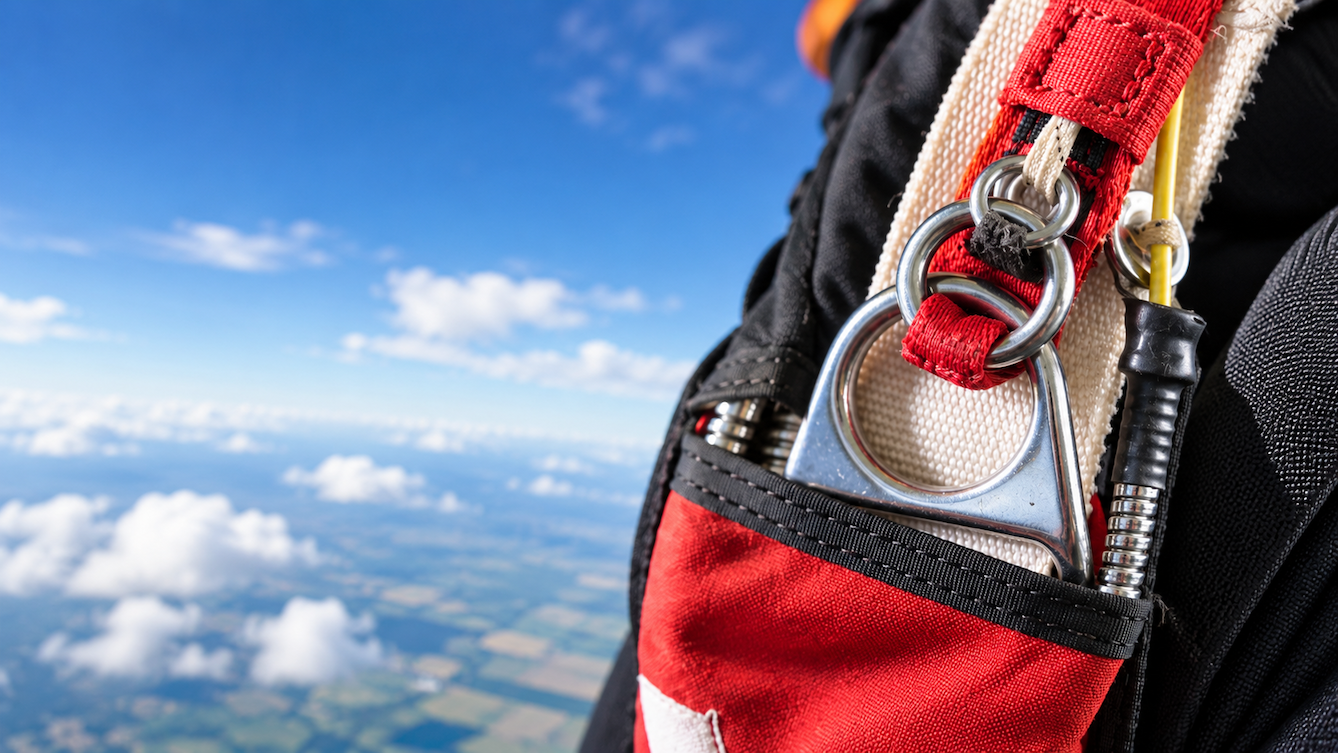
Three metal rings, a few lines of webbing — and one of the cleverest pieces of engineering in skydiving.
A parachute needs to stay securely connected to the harness throughout a jump. But what happens if the main canopy malfunctions and needs to be released? Skydivers need a reliable way to disconnect it so that the reserve parachute can be deployed. This is where the three-ring release system comes in. Invented by Bill Booth in 1976, it made releasing the main canopy much simpler and more practical than earlier systems.
The clever part is its use of mechanical advantage.
he three rings work together like a series of levers, multiplying the effect of the force applied to the release mechanism. This means the system can hold the substantial forces involved in parachute deployment while still allowing the main canopy to be released with relatively little effort. It is a remarkably elegant solution: instead of relying on a large, complicated piece of hardware, it uses a simple arrangement of rings, webbing and a retaining mechanism.
Another important detail is what happens after the main canopy is released. The system is designed so that the remaining hardware is smooth and less likely to interfere with the reserve parachute as it deploys. Its simplicity, reliability and practical design helped make the three-ring system a standard feature of modern sport parachuting equipment.
Sometimes the smartest engineering doesn’t look complicated at all. In this case, it looks like three rings — and a very good idea.

How It Works and What Should Be Inspected?
If the main parachute needs to be released, pulling the dedicated cutaway handle activates a mechanism that releases the retaining loop holding the three rings together. The rings then separate in sequence, disconnecting the main canopy from the harness. Before every jump, the system must be checked as part of the overall equipment inspection, following the manufacturer’s instructions and established procedures. If there is any doubt about correct assembly, wear or damage, the system should be inspected by a qualified parachute rigger.